

Analyst Insight

Stock Markets and Concentration Risk
A competitive economy will always have winners and losers. While some firms thrive, others may lag and this can reduce competition and dwindle creativity, resulting in increased profits and stock market capitalization for a small number of highly successful firms. As these firms become larger, their general power within the marketplace and the wider economy strengthens. In some nations, large companies can, for instance, use their influence to suppress new business and their access to capital, thereby increasing the barriers to entry in their respective industries.
More specific to stock markets, however, the significant size of only a few companies relative to the overall market, places stock market indexes in a position where the market moves up, down, or sideways, depending on the performance of only a few companies.
Market Capitalization and the Jamaica Stock Exchange (JSE)
The JSE Market is in a position where there is considerable concentration risk among specific companies, particularly those within the financial sector. Looking at the twelve months ending Dec 31, 2021, we observe that both the Junior Market Index and the Manufacturing and Distribution Index performed well, delivering growth of 29.69% and 21.19%, respectively. However, despite their returns being over 20%, the combined index, which is a combination of several indices (including Junior and Manufacturing & Distribution) only increased by 2.22%. This was a result of the poor performance of the heavily weighted financial index which declined by 3.96% in 2021. As at January 28, 2022, the JSE’s financial index accounted for 59.6% of the total stock market capitalization, which means the sector plays a significant role as it relates to the direction of the Combined Index.
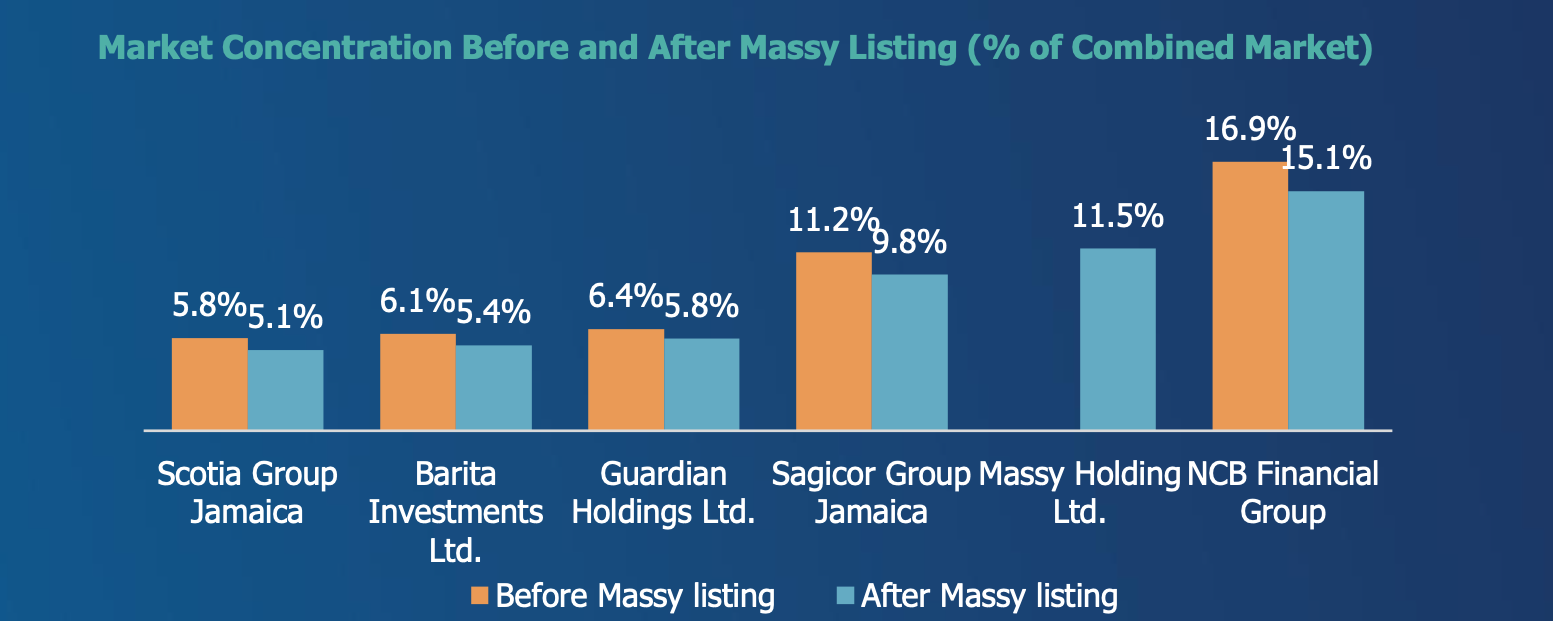
Investors should note that while on the surface, the Combined Index has become more exposed to the financial sector given Massy’s addition to the JSE’s Financial Index, we argue that the opposite has happened, i.e., Massy has not only reduced the JSE’s exposure to the financial sector but the Index’s exposure to large financial companies like NCBFG, Sagicor, Guardian holdings, Barita, and Scotia to name a few. This can be seen in the graph below. Importantly, while Massy is considered a financial company because it is an Investment Holding Company, Massy’s main exposure is not to financial services. Its main portfolios are Gas Products, Integrated Retail and Motors and Machines, so its exposure to the Financial Services industry is small while its true exposure is more so within the real economy, in industries such as medical oxygen, motor vehicles sales and rentals, supermarket operations etc. Consequently, the listing of Massy on the JSE is an important step towards not only regional integration but also a more robust and diverse stock market. Looking briefly at the S&P 500 index, we can see that the largest company, Apple, only has a weighting of 6.7% while NCBFG has a weighting of 15.1% in the Combined Index. This implies that while we have improved our position following the addition of Massy, more companies are needed to enhance the diversification of the Index which ultimately benefits investors.
Concluding Thoughts – Empirical Evidence
In conclusion, we must note that there has been empirical evidence to support the need for greater market diversification. According to Bae et al., “a stock exchange dominated by disproportionately large firms would be less sensitive to the needs of start-up firms to raise equity. This process inhibits the ideal cycle of competition, innovation, creative destruction, and economic growth, just as product market concentration can yield larger profits and valuation for winners rather than enhancing the economy as a whole.” The research paper investigated the relations between stock market concentration and economic growth, capital efficiency, initial public offerings and innovation across 47 countries during the 1989 to 2016 period. Their key findings are that stock market concentration today is significantly and negatively related to economic growth five or even ten years in the future. The addition of Massy Holdings was a step in the right direction, a step to decrease our stock market concentration while providing diversification to our local market and promoting economic growth.
References: (Bae, K.-H., Bailey, W., & Kang, J. (2021). Why is stock market concentration bad for the economy? Journal of Financial Economics, 140(2), 436–459. https://doi.org/10.1016/j.jfineco.2021.01.002 )
 |
Written by Jonathan Cook, Investment Strategy Analyst |
Full Newsletter & Report